
Published March 27, 2026
Why More Homes Are Selling Below Asking (And What Sellers Need to Do About It)

The Headline Everyone Sees
At first glance, the stat grabs your attention:
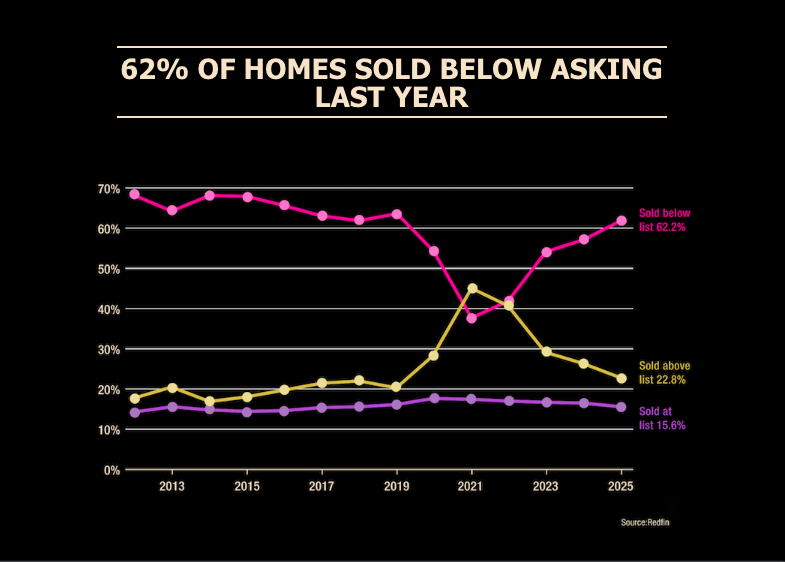
Over 62% of homes sold below asking price last year — the highest share we’ve seen in six years.
And paired with that?
List prices are still up about 2.5% year over year… but actual sale prices are trending down.
That disconnect is where the real story lives.
The Trend Most People Miss
If you zoom out, this isn’t a one-year anomaly—it’s a shift that’s been building since 2021.
Back then, the market rewarded aggressive pricing and often pushed buyers to compete above list. But since that peak, we’ve seen a steady reversal:
More homes selling below asking.
Fewer homes selling above asking.
Not dramatically overnight—but consistently.
And that consistency matters more than any single stat.
Because markets don’t usually snap back—they evolve.
What This Means for Sellers Right Now
Here’s the part that can be hard to hear (but matters most):
The market is no longer correcting for pricing mistakes.
A few years ago, you could price high and let buyer competition do the work for you. Today, that same strategy often leads to:
Longer days on market
Price reductions
Negotiating from a weaker position
Buyers are still out there—but they’re more selective, more informed, and less willing to stretch beyond perceived value.
That doesn’t mean homes aren’t selling.
It means how they sell has changed.
The Strategy Shift (This Is the Aha)
This is where pricing becomes less of a number… and more of a strategy.
The sellers who are winning right now aren’t guessing. They’re:
Positioning their home intentionally from day one
Understanding how buyers are interpreting value
Creating urgency instead of chasing it
Because pricing isn’t just about what you want to get.
It’s about how the market will respond.
Why This Trend Isn’t Likely to Reverse Soon
There’s no clear indicator that this pattern is going to suddenly flip back.
Inventory is stabilizing.
Buyers have more options.
And interest rates have shifted buyer behavior toward caution instead of urgency.
All of that supports a more balanced—or even buyer-leaning—environment.
Which means:
Overpricing doesn’t just “sit”… it costs you.
In time, leverage, and often in final sale price.
What We’re Telling Our Sellers
Every listing conversation we have right now includes this exact discussion.
Not to create fear—but to create clarity.
Because the goal isn’t to “test the market.”
The goal is to position your home to win in it.
That means walking through:
What similar homes are actually selling for (not just listing for)
Where buyer demand is strongest
What pricing strategy will create the best outcome—not just the highest number on paper
The Bottom Line
The takeaway isn’t that the market is “bad.”
It’s that the rules have changed.
And in this version of the market, preparation beats optimism every time.
The sellers who understand that—and price accordingly—are the ones still getting strong results.

Josh Voyles
Realtor® Broker Associate | Voyles Realty Group | Keller Williams Saint Louis
or another way